
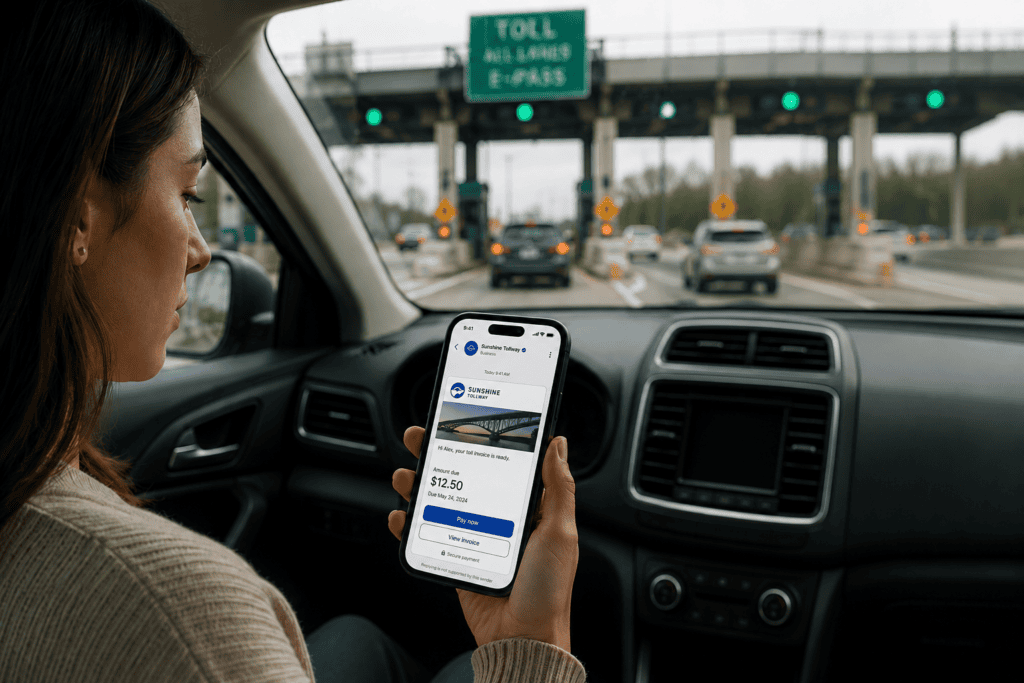
The transition to All-Electronic Tolling (AET) is officially complete across North America’s busiest travel corridors. From the recently updated bridge and tunnel toll structures across the Northeast to the rapidly expanding managed lane networks on North Carolina’s Turnpike system, physical cash booths have been completely phased out.
On paper, this shift represents a triumph for operational efficiency, carbon emission reductions, and driver throughput. In reality, it has triggered a massive, high-stakes crisis in cash flow and collections management: the customer “ghosting” crisis.
With physical barriers removed, tolling agencies are entirely dependent on digital invoices to collect revenue from non-transponder users. Yet, industry data from mid-2026 reveals a deeply concerning trend—drivers are ignoring, blocking, or deleting digital toll invoices, text alerts, and email notifications at record high rates.
Traditional communication channels have collapsed under the weight of consumer fatigue and rampant digital fraud. For tolling authorities, departments of transportation, and collections partners, resolving this disconnect is no longer just a customer service goal; it is a critical revenue recovery mandate.
Building directly upon recent industry discussions with fintech and collections innovators like SWC Group and CSG regarding Smarter Lost Revenue strategies, the conversation is shifting away from lowest-bid procurement habits and moving toward high-trust customer experience management. The most promising solution on the horizon? Rich Communication Services (RCS) messaging.
The Messaging Breakdown: Why SMS Has Lost the Public’s Trust
To understand why toll consumers are ghosting digital invoices, we have to evaluate the current state of mobile communication through the lens of psychology and cybersecurity.
For the past decade, Short Message Service (SMS) text alerts and standard emails have been the default tools for toll agencies running “Tolls by Mail” or license-plate-based billing. A camera reads a plate, a database pinpoints an address or mobile number linked to registration, and an automated system texts: “You owe $8.50 for using Expressway X. Click here to pay.”
In 2026, that text is dead on arrival.
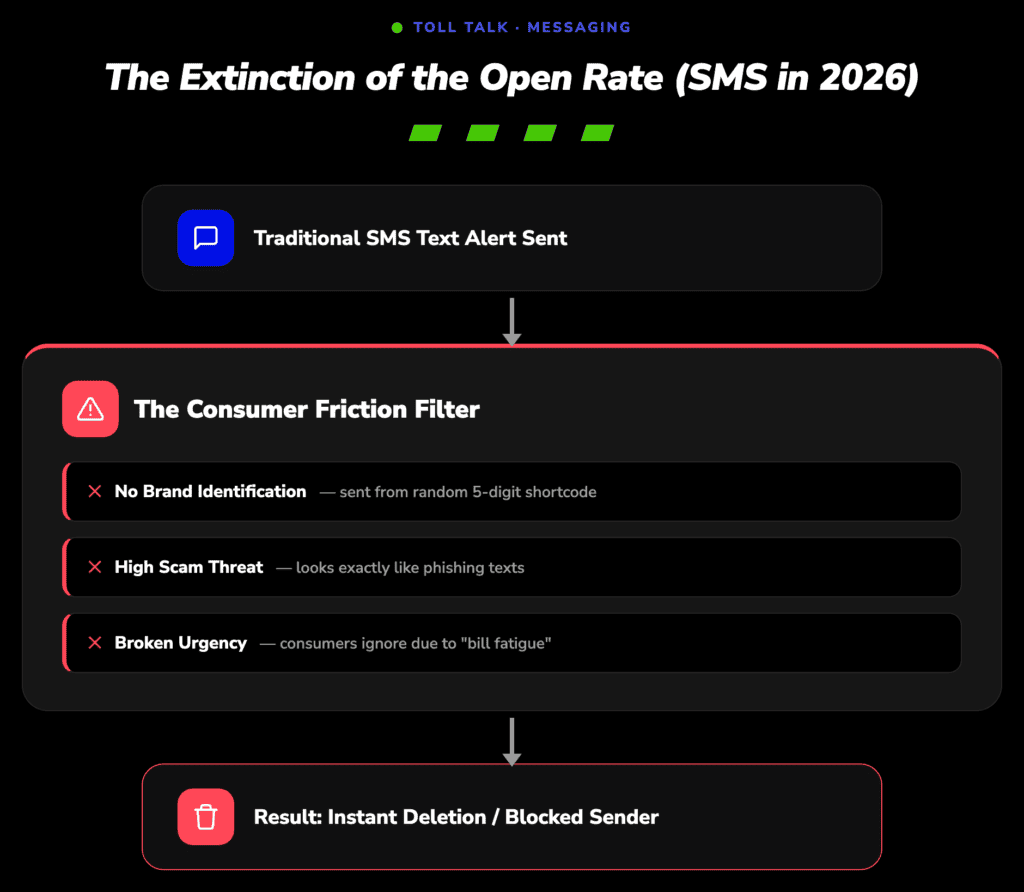
The reason for this structural failure is simple: traditional SMS lacks a layer of trust. The consumer’s phone inbox is a warzone of spam, shipping delivery scams, and malicious phishing links. Because standard SMS displays notifications from an unverified, random shortcode or five-digit number, an authentic text from a tolling authority looks identical to a fraudulent attempt to steal credit card data.
Consumers have been conditioned by cybersecurity experts to never click on a link from an unverified source. When a tolling authority sends an unbranded, plain-text link demanding payment, honest drivers frequently delete the message out of an abundance of caution, assuming it is a phishing scam.
The resulting friction causes open rates to plummet, leaving agencies to watch aging receivables pile up while printing and mailing physical paper invoices that cost more to process than the value of the toll itself.
Enter RCS: Transforming Passivity into Verified Engagement
Rich Communication Services (RCS) is the modern replacement for traditional SMS, bringing the feature-rich capabilities of standalone messaging apps (like WhatsApp, iMessage, or WeChat) directly into the native texting inbox of every major mobile operating system. Following a massive industry push over the last two years, RCS has reached near-universal compatibility across iOS and Android ecosystems.
For tolling agencies struggling with customer friction, RCS completely alters the relationship by removing anonymity from digital communication.
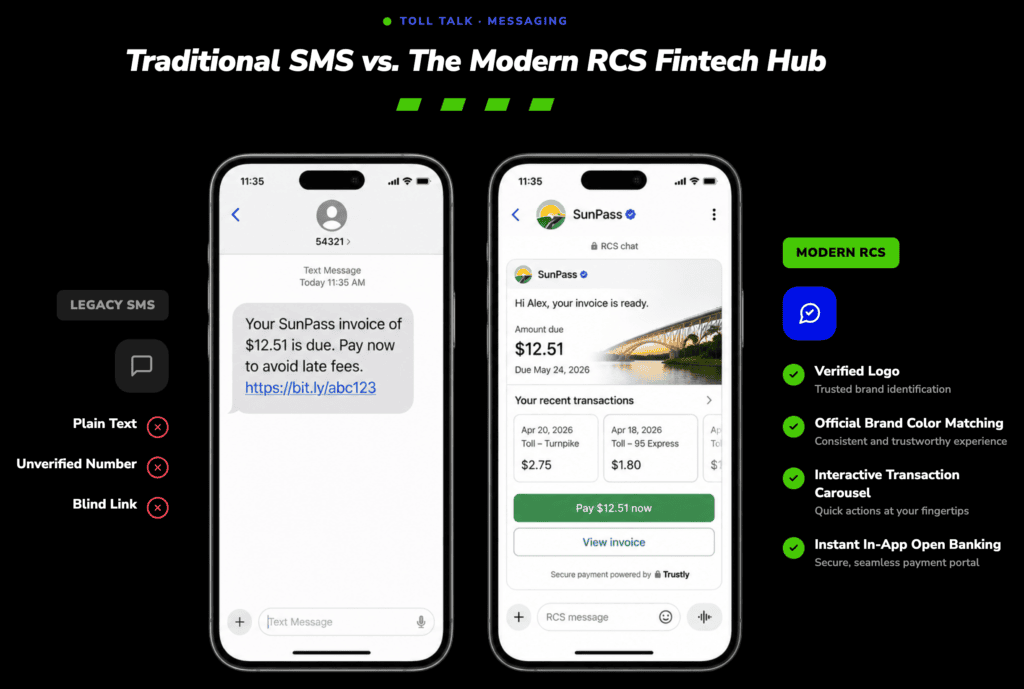
1. Verified Sender Branding
When an agency triggers an RCS notification, the customer does not see a sketchy shortcode. Instead, the message loads with the agency’s official corporate logo, matching brand color palettes, and a distinct, verified checkmark icon authenticated by global carrier networks. This visual verification instantly communicates legitimacy, immediately defusing the consumer’s defensive “phishing scam” filter.
2. High-Capacity Embedded Interactivity
Unlike a static SMS that caps characters and breaks links, an RCS template supports rich media layouts. An agency can display an image of the vehicle crossing beneath a specific gantry, show an interactive map of the route driven, or lay out a structured grid breaking down the base toll versus administrative fees.
3. Integrated Micro-Transactions
RCS enables users to execute tasks without ever leaving their texting application. Instead of redirecting a user to a slow-loading, external web portal that requires password entry and manual card typing, RCS lets drivers view their statement, select outstanding balances, and complete an encrypted payment via Apple Pay, Google Pay, or integrated open banking rails—all within three taps inside the native message thread.
Smarter Revenue Recovery: Moving Beyond the “Lowest-Bid” Mentality
For decades, public toll procurement has been trapped in a race to the bottom, prioritizing the “lowest-bid vendor” for collections and printing services. This old playbook relies on an aggressive, analog strategy: wait for a bill to hit 90 days past due, slap it with a punitive late fee, print a threatening notice, and ship it to a collections agency.
The mid-2026 financial realities prove that this legacy model is highly inefficient. Punitive, delayed enforcement damages customer relationships and yields incredibly low recovery percentages from casual or out-of-state drivers. High-performing back-offices are utilizing RCS templates to transition toward Early-Stage Conversational Collection.
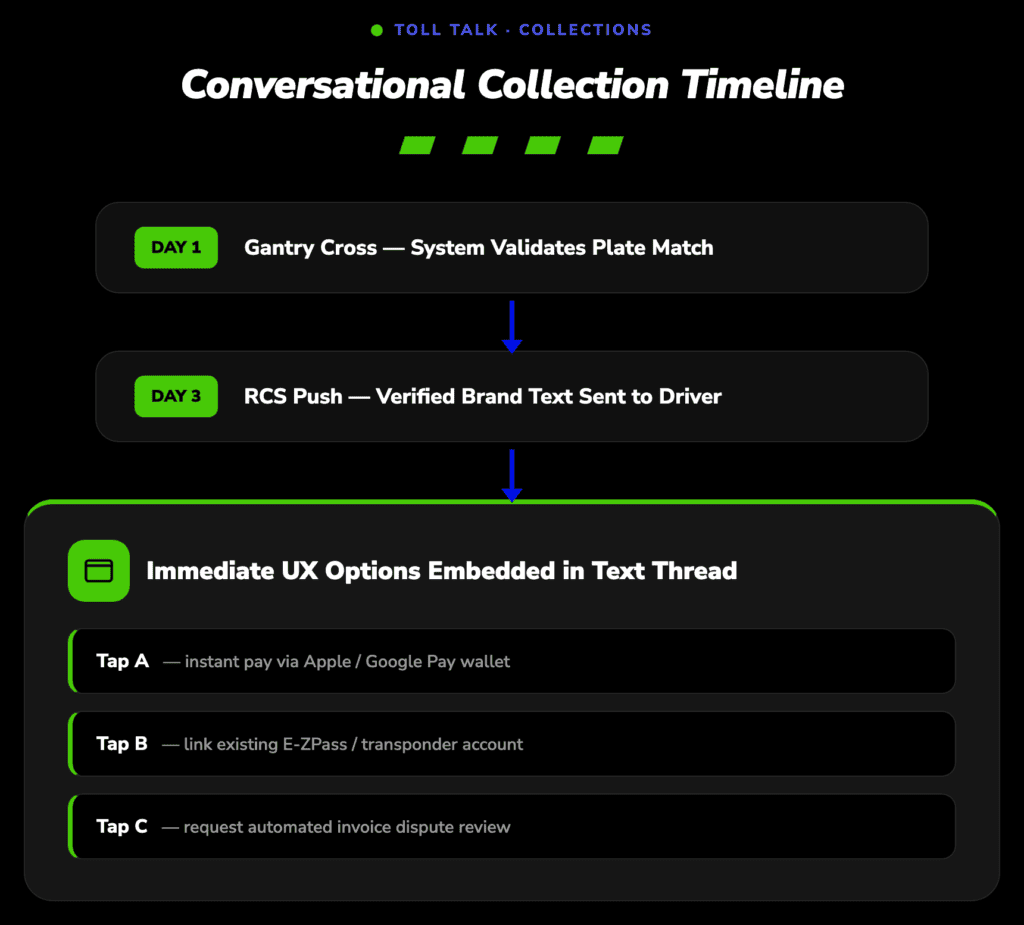
By communicating through a high-trust, interactive interface within 72 hours of the toll event, agencies give drivers the opportunity to settle their balances long before it escalates into a stressful collections dispute.
If a driver doesn’t have an active transponder, the RCS alert can present a customized call-to-action card: “Pay this $6.00 toll now, or check this box to convert this transaction into a new transponder account with a pre-loaded $20 balance, and we will waive your processing surcharge entirely.” This shifts the communication strategy from a punitive bill-collection mechanism into an active onboarding and customer-retention channel.
Overcoming the Implementation Hurdles: Data Privacy and Carrier Routing
While the operational advantages of Rich Communication Services are undeniable, transitioning a public tolling framework to an RCS-centered communication architecture introduces unique logistical and technical challenges.
1. Data Integrity and Multi-Carrier Provisioning
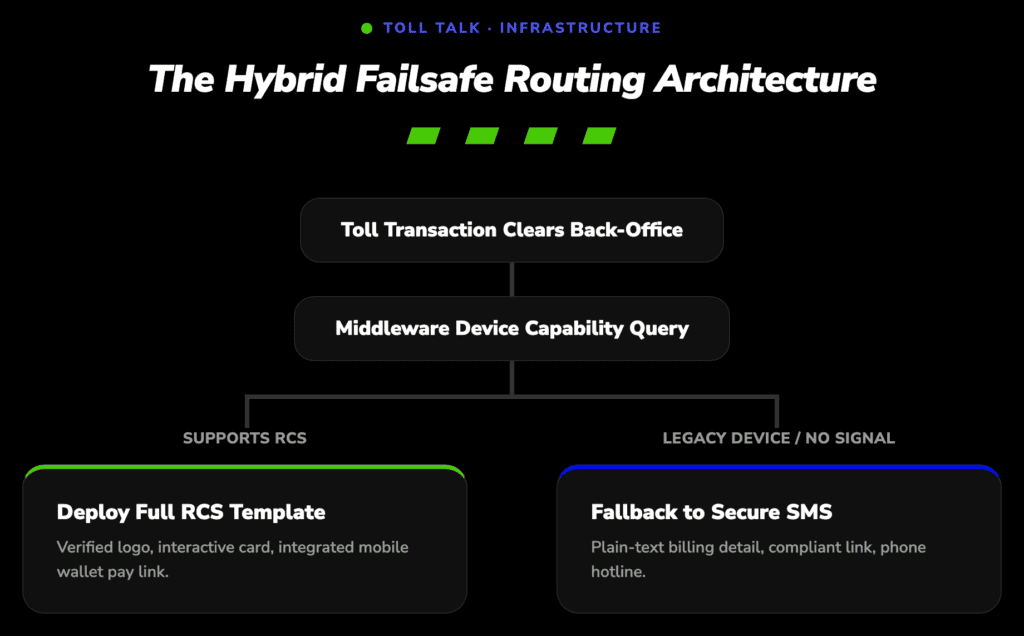
Unlike standard SMS broadcast engines that blindly blast strings of characters across generic cellular gateways, RCS campaigns require structured data handshakes. Toll back-offices must coordinate with specialized conversational middleware providers—such as Sinch, Twilio, or Infobip—to ensure messages are properly routed across diverse mobile carriers (Verizon, AT&T, T-Mobile) while keeping customer data secure.
The transaction system must dynamically check the status of the recipient’s handset. If a customer is traveling in an area with degraded cellular coverage or uses an older device that cannot read rich media packets, the routing engine must feature an automated, seamless fallback loop that degrades to a secure, standardized SMS script to ensure the invoice legal notification requirement is fulfilled.
2. Safeguarding Consumer Privacy
Tolling records are deeply personal; they represent a detailed historical archive of a consumer’s physical movements across a region. Because public agencies are bound by strict data governance legislation, any rich messaging platform must deploy rigorous end-to-end encryption.
Vehicle identifiers, license plate images, and payment card industry (PCI) tokens cannot float unprotected over public messaging servers. To maintain compliance, the middleware provider must act purely as an encrypted transport layer, processing the information without archiving or caching personal identifying information (PII) on external commercial databases.
The Toll Talk Takeaway: Trust is Your Most Profitable Asset
The “Ghosting” crisis isn’t actually a failure of customer compliance; it’s a structural breakdown in communication technology. When toll authorities broadcast unverified messages that mirror the tactics of bad actors, they cannot blame consumers for hitting the “Delete and Block” button.
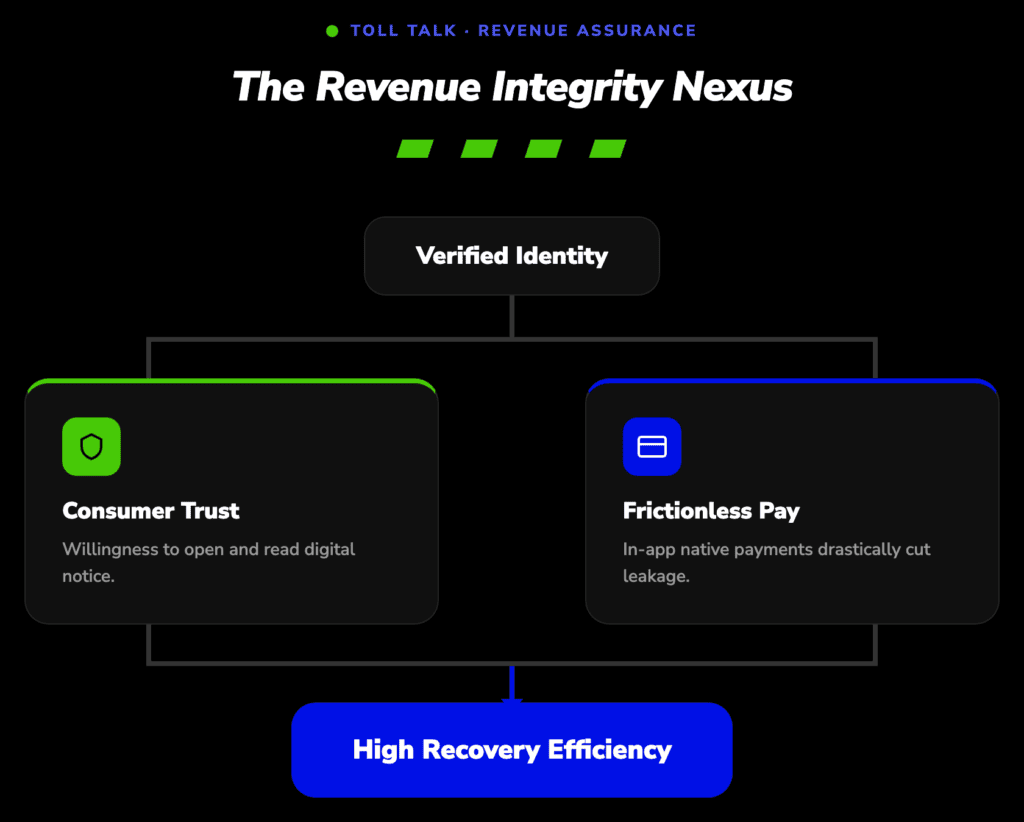
The core lesson from mid-2026 is that revenue security is directly tied to customer user experience. By investing in conversational platforms like RCS, tolling organizations can reclaim their identity in the mobile inbox, provide frictionless, transparent payment paths, and completely bypass the expense of traditional paper collections.
In a cashless ecosystem, trust is your most valuable asset. The organizations that step forward to build transparent, secure, and branded digital communication strategies won’t just see their open rates skyrocket—they will safeguard their balance sheets for the highway ahead.