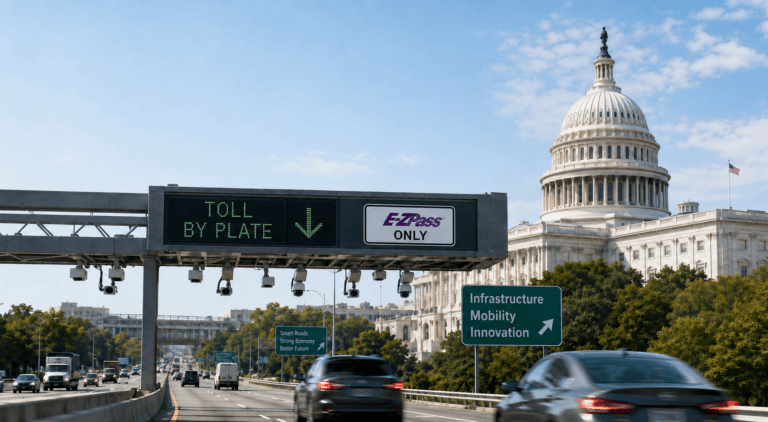




When most drivers think about tolling, they rarely think about payments.
They think about getting where they’re going.
That’s exactly the point.
The best payment experience is one that fades into the background—fast, secure, and almost invisible. Whether a driver uses a transponder, mobile app, license plate billing, or digital wallet, they expect the transaction to happen effortlessly. The moment payment becomes confusing or inconvenient, it quickly overshadows the entire customer experience.
That shift in consumer expectations is changing how transportation agencies think about payments.
On a recent episode of Toll Talk Podcast, Luis Guzman, Senior Sales Executive of Strategic Partnerships at CSG, shared his perspective on where the payments industry is headed. His vision extends well beyond processing transactions. Instead, he sees a future where artificial intelligence, embedded finance, and strategic partnerships work together to remove friction from every step of the customer journey.
His perspective aligns with one of the biggest trends occurring across financial services today: payments are no longer simply a back-office function—they’ve become a core part of the customer experience.
From Toll Booths to Invisible Payments
The tolling industry has undergone one of the most dramatic payment transformations of any public infrastructure sector.
Not long ago, drivers stopped at toll plazas, searched for cash, waited in line, and continued on their journey. The introduction of electronic toll collection, transponders, and open-road tolling dramatically improved efficiency. Today, many travelers drive through toll facilities without slowing down.
The next evolution is already underway.
Across retail, hospitality, transportation, and e-commerce, consumers are embracing what payment experts call embedded and invisible payments. Embedded payments integrate transactions directly into an app or digital experience, while invisible payments remove the payment step almost entirely. Think about ordering coffee ahead on your phone or walking out of an Amazon Go store without stopping at a checkout lane. The transaction happens automatically, allowing customers to focus on the experience rather than the payment itself. https://www.atlantafed.org/research-and-data/publications/take-on-payments/2025/06/16/rise-of-embedded-and-invisible-payments
Luis believes tolling is naturally positioned for this future.
Rather than asking customers to initiate every payment, connected vehicles, digital identities, biometrics, and interoperable systems could eventually communicate directly with transportation infrastructure. Drivers simply travel, while payment happens securely behind the scenes.
For agencies, this means fewer friction points. For motorists, it creates a simpler, more intuitive travel experience.
Customer Expectations Are Driving Innovation
Transportation agencies aren’t competing only with other toll roads anymore.
They’re competing with every digital experience consumers have.
When someone uses Apple Pay at a grocery store, orders dinner through Uber Eats, or pays a utility bill with a single tap, those experiences shape what they expect everywhere else—including tolling.
Research from the Federal Reserve Bank of Atlanta notes that consumers increasingly expect payment experiences to be integrated into the products and services they use every day. As embedded and invisible payments continue to grow, convenience is becoming the new baseline rather than a premium feature. https://www.atlantafed.org/research-and-data/publications/take-on-payments/2025/06/16/rise-of-embedded-and-invisible-payments
That means agencies must think beyond simply accepting payments.
They need to create payment experiences that are intuitive, transparent, and flexible.
Customers want options. Some prefer automatic replenishment. Others use digital wallets. Some still rely on traditional ACH or debit cards. Meeting customers where they are has become an essential part of delivering quality public service.
AI Is Making Payments Smarter
Artificial intelligence often dominates conversations around customer service and automation, but its impact on payments may prove even more significant.
During the podcast, Luis described how AI can transform payment orchestration by creating more conversational, personalized experiences while reducing friction throughout the payment journey. Instead of navigating multiple screens or manually completing repetitive tasks, customers may soon interact with intelligent systems that proactively guide them through the process.
Behind the scenes, AI is already helping financial institutions:
- Detect fraud in real time
- Analyze payment behavior
- Reduce false declines
- Improve payment routing
- Deliver personalized reminders
- Verify account information faster
As payment volumes continue growing, these capabilities become increasingly important.
The Federal Reserve recently reported that noncash payments reached 236.6 billion transactions in 2024, with ACH payments accounting for nearly three-quarters of total payment value. At the same time, check usage continues to decline while digital payment methods continue to expand. https://www.federalreserve.gov/newsevents/pressreleases/other20260701a.htm
For toll agencies processing millions of transactions each year, automation isn’t simply about convenience—it’s becoming operationally necessary.
Partnerships Are Becoming a Competitive Advantage
Technology alone won’t shape the future of payments.
Partnerships will.
Throughout the episode, Luis repeatedly emphasized that collaboration between agencies, banks, payment providers, fintech companies, and technology vendors creates stronger solutions than organizations can build independently.
This shift is already visible throughout the payments ecosystem.
Historically, banks and fintech companies were often viewed as competitors. Today, many of those same organizations work together to deliver integrated payment experiences that combine financial expertise, security, and innovation.
For tolling agencies, these partnerships create opportunities to:
- Launch new payment methods faster.
- Improve fraud detection.
- Reduce implementation costs.
- Increase interoperability.
- Deliver better customer experiences.
Rather than asking, “Who owns this technology?” agencies are increasingly asking, “Who can help us build the best experience for our customers?”
That mindset changes everything.
The Future Is About Choice
One of the strongest themes from Luis’s conversation was flexibility.
Not every customer wants to pay the same way.
Some rely on transponders.
Others prefer license plate billing.
Many increasingly expect Apple Pay, Google Pay, PayPal, or other digital wallets.
Businesses are thinking similarly. According to a Federal Reserve Financial Services survey, 66% of businesses say they would likely use instant payments if offered by their financial institution, with growing interest in digital wallet funding, recurring payments, and real-time transactions. https://www.frbservices.org/news/fed360/issues/050125/industry-perspective-faster-payments-survey-business
For transportation agencies, supporting multiple payment methods isn’t just about keeping pace with technology—it’s about serving diverse communities with different financial preferences and accessibility needs.
Choice builds trust.
Rethinking Procurement for a Digital Future
Technology innovation often moves faster than government procurement.
Luis highlighted an important challenge facing many toll agencies: payment services are frequently bundled into larger back-office procurements, limiting competition and preventing agencies from selecting the best available payment technology.
As digital payments evolve more rapidly, procurement strategies may need to evolve alongside them.
Agencies that prioritize open integrations, interoperability, and flexible technology ecosystems position themselves to adopt new innovations more quickly without replacing entire back-office systems.
In other words, modernization isn’t just about purchasing new software.
It’s about creating an ecosystem that can adapt as technology changes.
The Customer Experience Is the Payment Strategy
Perhaps the most important takeaway from Luis’s conversation is that organizations should begin with the customer—not the technology.
Before evaluating AI platforms, payment gateways, fraud tools, or digital wallets, agencies should ask a simpler question:
What experience do we want our customers to have?
When that vision is clear, technology decisions become much easier.
Customers don’t remember which payment processor handled their transaction.
They remember whether paying was easy.
They remember whether they trusted the system.
They remember whether the experience respected their time.
As digital payments continue evolving, the organizations that succeed won’t necessarily be those with the newest technology.
They’ll be the ones that use technology to make life simpler for the people they serve.
And in transportation, that’s exactly where the future is headed.