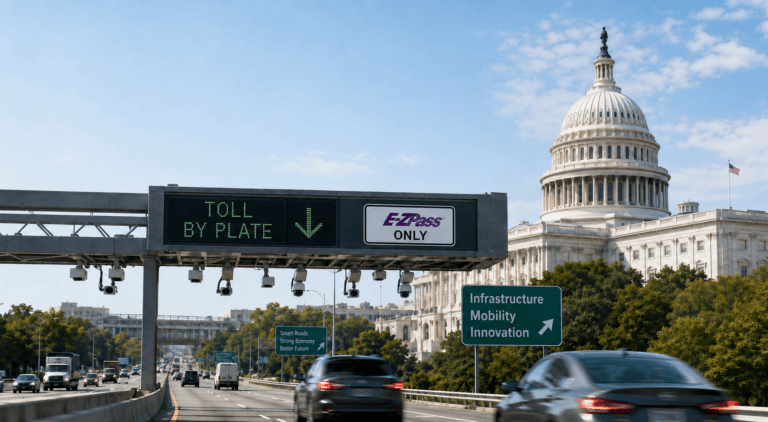

Revenue recovery remains one of the most consequential challenges facing tolling agencies today. As operating costs increase and economic uncertainty continues to influence consumer behavior, agencies must reevaluate how they approach lost revenue programs.
In this episode of Toll Talk, hosts Alexander Fakeri and Kalie Jakovics are joined by Kevin Bennick, Chief Revenue Officer at SWC Group, to examine what smarter lost revenue strategies in tolling truly require in today’s environment. Drawing from more than three decades in the call center and collections industry, Kevin provides practical insight into how agencies can recover more revenue while maintaining fairness and public trust.
For more industry conversations and insights, visit the full Toll Talk Podcast episode archive.
You can also learn more about the podcast hosts on the Meet the Hosts section of our website.
Why Lost Revenue Strategies Must Evolve
Across the country, tolling authorities are managing multiple pressures simultaneously. Inflation has raised the cost of operations. Migration trends are shifting traffic volumes across state lines. Procurement processes often prioritize lowest cost over long-term value. Meanwhile, some agencies continue to report substantial volumes of uncollected tolls.
The central question becomes clear: How can agencies strengthen recovery efforts without increasing toll rates?
Kevin emphasizes that smarter lost revenue strategies in tolling begin with maximizing the revenue already owed before considering rate increases. Effective programs focus on efficiency, data-driven decision-making, and customer engagement rather than relying solely on reactive collections.
Proactive Early Outreach as a Core Strategy
One of the most effective components of a modern recovery program is proactive early outreach. Rather than waiting for accounts to become severely delinquent, agencies can initiate communication at earlier stages of the lifecycle.
Proactive outreach may include:
- Early reminder communications before penalties escalate
- Targeted segmentation based on payment behavior
- Multi-channel engagement strategies including phone, email, and digital notifications
This approach increases voluntary compliance, reduces customer frustration, and decreases the administrative burden associated with escalated disputes. When customers are contacted early and respectfully, recovery rates improve and public perception remains positive.
Multi-Tiered Collection Programs That Deliver Measurable Results
Smarter lost revenue strategies in tolling also rely on structured, multi-tiered collection programs. These programs differentiate accounts based on risk profiles, payment history, and behavioral data. Rather than applying a uniform approach to all accounts, agencies can tailor communication and escalation processes accordingly.
A multi-tiered framework typically includes:
- Early-stage soft outreach
- Mid-stage structured repayment options
- Late-stage targeted recovery efforts
Agencies that have adopted sophisticated tiered programs have consistently achieved higher recovery rates compared to traditional one-size-fits-all approaches. The key lies in using analytics to guide strategy while preserving fairness and compliance.
The Role of AI in Revenue Recovery and Customer Service
Artificial intelligence is increasingly integrated into tolling customer service centers. AI-assisted tools are improving operational efficiency while enhancing the customer experience.
Examples include:
- Intelligent virtual agents that handle routine inquiries
- Speech analytics systems that improve quality assurance
- Automated routing that reduces average speed of answer
- Multilingual capabilities that expand accessibility
Importantly, Kevin underscores that AI should enhance human performance rather than replace it. Complex disputes, emotionally charged interactions, and nuanced cases still require live representatives who can demonstrate empathy and sound judgment.
The future of revenue recovery is not purely automated. It is a balanced model that combines machine efficiency with human expertise.
If you are interested in how AI is shaping the tolling industry more broadly, we recommend reading related conversations such as HCTRA’s David Patterson on AI Patents & Meaningful Sustainability.
AI should enhance human performance rather than replace it. Complex disputes and emotionally sensitive interactions still require live representatives who can demonstrate empathy and sound judgment.
Economic Indicators Shaping the 2026 Outlook
The episode also addresses macroeconomic factors influencing toll revenues. Kevin highlights key consumer indicators such as mortgage performance, auto loan delinquencies, and communication service payments as signals of broader economic trends.
Rising auto loan delinquencies, in particular, may have downstream effects on vehicle usage and toll payment behavior. Additionally, interstate migration patterns are reshaping traffic volumes and infrastructure demands across different regions.
Agencies that align revenue recovery strategies with economic data will be better positioned to remain resilient through 2026 and beyond.
For additional leadership and industry perspective, you may also explore:
- Driving Change – A Conversation with James Hofmann, NTTA’s CEO & IBTTA President
- Pat Jones: 23 Years, Family, Legacy, Leadership & Reflections on the Tolling Industry
These episodes provide additional insight into strategic leadership and long-term industry evolution.
The Procurement Challenge: Value Versus Lowest Cost
Another important theme discussed in the episode is procurement strategy. While cost management is necessary, consistently awarding contracts based solely on lowest bid can weaken overall recovery performance.
A value-based approach considers:
- Vendor expertise and specialization
- Demonstrated recovery outcomes
- Compliance controls and oversight
- Long-term operational sustainability
Smarter lost revenue strategies in tolling require procurement decisions that balance fiscal responsibility with measurable performance.
Building a Resilient Future for Tolling Agencies
Revenue resilience does not result from a single tactic. It requires a comprehensive strategy that integrates proactive outreach, data-driven segmentation, advanced technology, and responsible procurement practices.
Agencies that modernize lost revenue programs while preserving fairness and transparency will be better equipped to navigate funding pressures, evolving customer expectations, and economic uncertainty.
Related Episodes from Toll Talk
To continue exploring industry innovation, customer experience, and operational strategy, consider these additional episodes:
- Young Professionals, Big Impact: Driving Change with IBTTA YPC
- Denver Bound: Jessica Carson Previews IBTTA’s 93rd Annual Meeting
- Driving the Future at Milligan Partners
You can browse all available conversations in the complete Toll Talk episode library.
Listen to the Full Episode
To hear the complete conversation with Kevin Bennick and explore these revenue recovery strategies in greater depth, listen to the full episode below or stream it on your preferred platform.
Stay up to date with future episodes covering tolling innovation, customer experience, and transportation leadership by subscribing wherever you listen to podcasts.