



The future of tolling isn’t just about technology—it’s about the people driving innovation behind the scenes.
In this episode of the Toll Talk Podcast, hosts Alex Fakeri and Kalie Jakovics welcome Saida Williams, Commercial Director of Traffic & Infrastructure at Indra, for an engaging conversation that explores both the evolution of tolling technology and the collaborative community shaping its future.
From artificial intelligence and connected vehicles to smarter infrastructure and the changing perception of toll roads, Saida shares insights from more than a decade in the industry while discussing where transportation is headed next. Whether you’re a transportation professional or simply interested in emerging mobility technologies, this episode provides an exciting look at what’s ahead.
“What gets you into tolling is one thing. What keeps you in tolling is the people.”
— Saida Williams
A Career Built on Innovation—and Relationships
Like many professionals in transportation, Saida didn’t set out planning a career in tolling. After working in defense and energy, a recruiter introduced her to the industry—an opportunity that would ultimately shape the next chapter of her career. More than a decade later, she has held leadership roles with several major technology providers before joining Indra as Commercial Director of Traffic & Infrastructure.
One of the themes that resonates throughout the episode is the unique culture within the tolling industry. Saida describes it as a close-knit community where conferences often feel more like reunions than networking events. While companies may compete in the marketplace, industry professionals regularly collaborate, exchange ideas, and work together to solve challenges that ultimately improve transportation for everyone.
It’s a refreshing reminder that innovation isn’t driven by technology alone—it’s driven by the people behind it.
Helping Shape the Industry Through IBTTA
In addition to her role at Indra, Saida currently serves as Chair of the IBTTA Council of Platinum Sponsors, helping support the association’s strategic initiatives while strengthening collaboration between agencies, consultants, and technology providers.
Organizations like the International Bridge, Tunnel and Turnpike Association (IBTTA) play an important role in advancing the industry by creating opportunities for education, collaboration, and the exchange of best practices. As transportation technologies continue to evolve, partnerships between the public and private sectors are becoming more important than ever.
Learn more about IBTTA: https://www.ibtta.org
Changing the Perception of Toll Roads
One of the most interesting discussions during the episode isn’t about technology at all—it’s about perception.
Saida explains that many people immediately associate tolling with paying a fee, but that view overlooks the broader value toll roads provide. Modern toll facilities help reduce congestion, improve travel reliability, fund critical infrastructure, and give drivers more choices about how they travel.
According to IBTTA, user-funded transportation remains one of the most sustainable ways to finance transportation improvements while allowing agencies to invest directly back into the roads and bridges drivers use every day. As cities continue to grow and travel demand increases, helping the public better understand these benefits will become increasingly important.
The Evolution of Tolling Technology
One of the biggest shifts discussed during the episode is how tolling infrastructure itself has evolved.
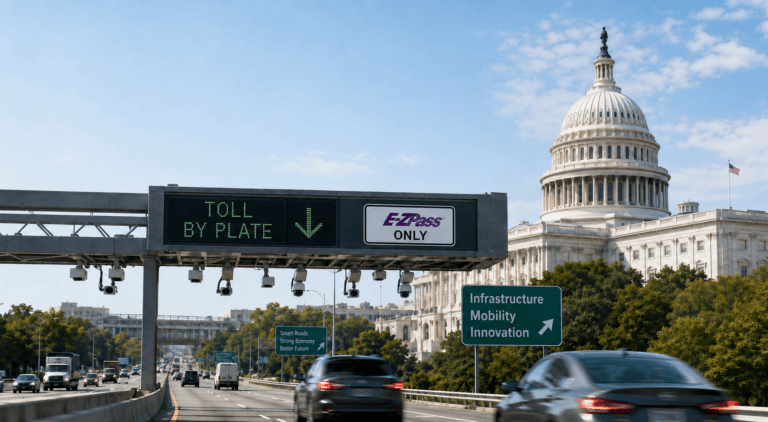
Historically, toll roads relied on significant roadside infrastructure, including sensors embedded in pavement, roadside cabinets, and extensive civil construction.
Today, systems are becoming dramatically simpler.
Saida explains how Indra has helped pioneer all-overhead tolling systems, reducing infrastructure installed within the roadway while lowering construction costs, maintenance requirements, and future disruptions.
This evolution isn’t just about reducing hardware—it’s about creating infrastructure that’s easier to maintain and upgrade over time. By moving more equipment overhead, agencies can often perform maintenance with fewer lane closures, reducing disruptions for motorists while improving worker safety.
The Federal Highway Administration (FHWA) has long recognized the benefits of electronic toll collection and open-road tolling, noting that these technologies help improve traffic flow, reduce delays, and lower vehicle emissions compared to traditional toll plazas.
As agencies continue modernizing their roadways, all-overhead systems are becoming an increasingly attractive solution for delivering reliable, scalable transportation infrastructure.
Learn more: https://ops.fhwa.dot.gov
AI Is Already Running Behind the Scenes
Artificial intelligence often feels like a technology of tomorrow.
In reality, it’s already powering many of the tolling systems drivers use every day.
During the episode, Saida explains that AI supports everything from license plate recognition and axle counting to occupancy detection, fraud prevention, and customer service automation.
Computer vision has become one of the industry’s most significant advancements. Instead of relying solely on physical sensors, AI-powered cameras can classify vehicles, verify occupancy for express lanes, and process millions of images with remarkable speed and accuracy. These technologies help agencies improve operational efficiency while reducing the need for manual review.
While much of this technology operates behind the scenes, drivers experience the benefits every day through faster toll processing, improved billing accuracy, and a more seamless travel experience.
One of the lighter moments during the episode comes when Saida shares some of the creative ways drivers have tried to fool occupancy detection systems—including mannequins and printed faces placed inside vehicles. While humorous, these examples highlight just how sophisticated today’s AI systems have become.
Learn more:
Connected Vehicles Are Closer Than You Think
Another major topic of discussion is Connected Vehicle-to-Everything (CV2X) technology.
Rather than relying entirely on roadside infrastructure, connected vehicles communicate directly with transportation infrastructure—and eventually with other connected vehicles—to improve safety, mobility, and efficiency.
This creates exciting opportunities including:
- In-vehicle toll payments
- Real-time roadway alerts
- Improved traffic management
- Faster incident notifications
- Enhanced driver safety
- Better traveler information
During the conversation, Saida discusses how CV2X technology is moving beyond pilot programs and into real-world deployments, including projects that combine toll payments with connected safety applications.
Looking even further ahead, the same connected infrastructure being deployed today will help support tomorrow’s autonomous vehicles. As connected and automated technologies continue to mature, agencies are laying the foundation for transportation systems that communicate seamlessly with both drivers and vehicles.
The U.S. Department of Transportation has identified connected vehicle technology as a key component of the future transportation ecosystem, helping improve roadway safety while creating a more connected travel experience.
Learn more: https://highways.dot.gov
Indra’s Global Impact
While many know Indra for its transportation work, the company is a global technology leader with solutions spanning intelligent transportation systems, transit, rail, air traffic management, and defense.
With more than 30 years of experience, Indra’s mobility technologies support approximately 78 million daily users while managing more than 110 million transportation transactions every day around the world. Those numbers illustrate the scale at which the company operates and the trust transportation agencies place in its technology.
Within tolling, Indra continues to invest in innovations like AI, connected vehicle technology, and next-generation roadside infrastructure that help agencies prepare for the future of mobility.
Learn more about Indra: https://www.indragroup.com
Key Takeaways
- Artificial intelligence is already transforming tolling through computer vision, automation, and smarter operations.
- Connected vehicle technology is creating new opportunities for safer roads and seamless toll payments.
- Modern all-overhead tolling systems help reduce infrastructure costs while improving maintenance and scalability.
- Organizations like IBTTA continue to foster collaboration that drives innovation across the transportation industry.
- The future of tolling is about more than collecting tolls—it’s about improving mobility, safety, and the overall traveler experience.
Final Thoughts
This conversation is a reminder that the future of transportation isn’t decades away—it’s already taking shape.
From AI-powered roadside systems and connected vehicles to smarter infrastructure and stronger industry collaboration, the technologies discussed throughout the episode are helping agencies create transportation networks that are safer, more efficient, and better prepared for tomorrow’s mobility challenges.
As Saida explains, innovation succeeds when great technology is paired with strong partnerships. It’s that combination of people, ideas, and forward-thinking leadership that continues to move the tolling industry forward.
Listen to this episode
Ready to hear the full conversation?
Episode 46: Smarter Roads, Smarter Cities: Inside the Next Era of Tolling features Saida Williams, Commercial Director of Traffic & Infrastructure at Indra, discussing artificial intelligence, connected vehicles, open-road tolling, smart infrastructure, and the future of mobility.
Listen now on your favorite podcast platform or explore more episodes at TollTalkPodcast.com.