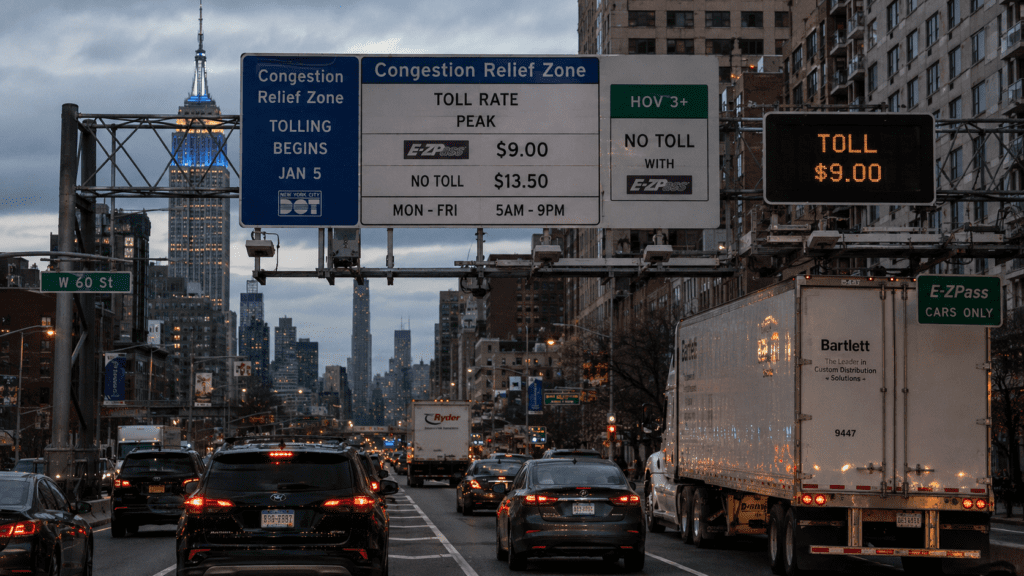
The eyes of the global transportation sector are locked squarely on Manhattan. After decades of political gridlock, environmental studies, lawsuits, and sudden administrative reversals, New York City’s Central Business District Tolling Program—commonly known as the Congestion Relief Zone—is officially live.
We are currently months into this sweeping urban traffic experiment. The initial $9 peak-period toll for passenger vehicles entering Manhattan south of 60th Street is no longer a theoretical debate on a legislative floor; it is a live daily transaction hitting hundreds of thousands of digital commuter accounts.
For the tolling industry, international transit authorities, and fintech providers, Manhattan is the ultimate testing ground. Congestion pricing sits at the volatile intersection of customer experience (CX), bleeding-edge roadside technology, and intense political friction. If the Metropolitan Transportation Authority (MTA) pulls this off cleanly, it will write the definitive blueprint for cities across North America—from Boston and Los Angeles to Chicago and San Francisco—who are desperate to fund public transit and unlock their paralyzed downtown grids. If it stumbles under data errors or public backlash, it could freeze urban road-user pricing initiatives for a generation.
This deep dive examines the operational data, financial clearinghouses, and on-the-ground engineering realities emerging from NYC’s historic deployment.
The Revenue Mechanics: Anatomy of the $9 Toll Structure
At the core of the Congestion Relief Zone is a complex pricing matrix designed to achieve two diametrically opposed goals: maximizing traffic diversion out of the dense core while minimizing administrative confusion for the average commuter.
The $9 daytime rate for passenger vehicles with a valid E-ZPass represents a careful political compromise, designed to ease the transition while still establishing a meaningful price signal to change driver behavior. However, the system’s operational complexity multiplies rapidly when looking at commercial fleets, non-transponder users, and off-peak travel windows.
The Heavy-Vehicle Burden and Light-Duty Distribution
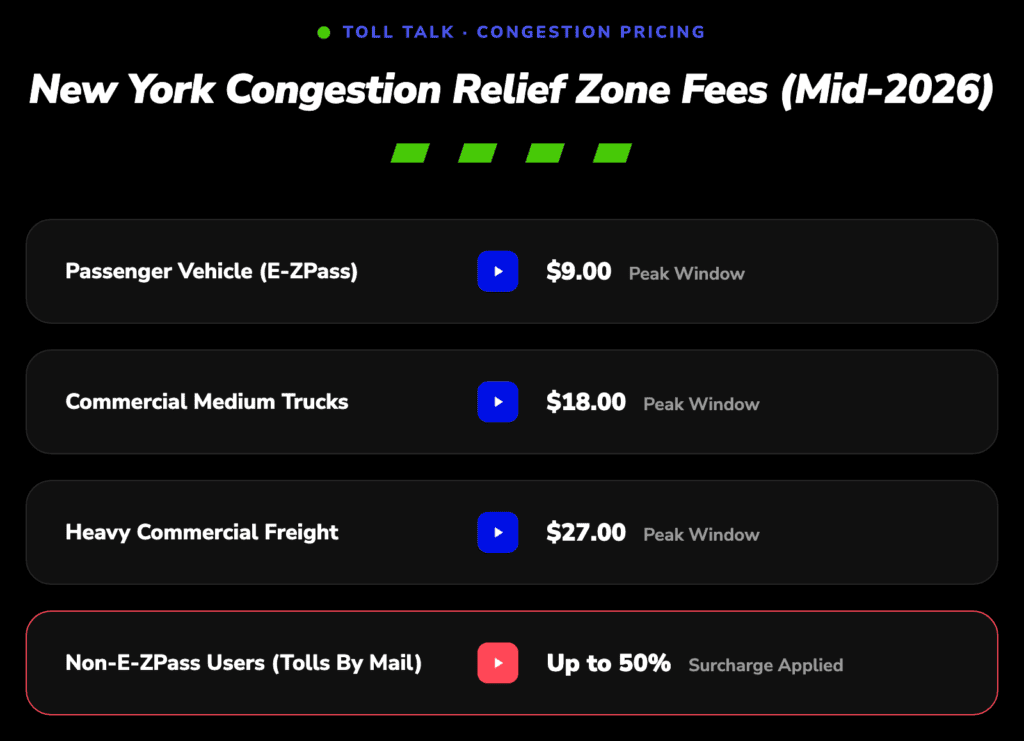
While passenger vehicles pay the baseline $9 rate during peak hours (5:00 AM to 9:00 PM on weekdays; 9:00 AM to 9:00 PM on weekends), commercial vehicles face significantly higher rates to reflect their greater impact on street congestion and infrastructure wear. Medium trucks are assessed an $18 peak fee, while heavy multi-axle freight haulers are charged $27 per entry.
Crucially, the system charges passenger vehicles only once per day for entering the zone, whereas commercial trucks are billed for every single unique entry throughout the daytime window. This specific rule has forced local logistics providers to completely re-engineer their localized urban routing.
The Non-E-ZPass Penalty and Revenue Leakage Threat
To discourage drivers from hiding or abandoning transponders, the MTA levies a punishing surcharge of up to 50% for vehicles processed via “Tolls by Mail” (license plate scanning). For a standard passenger car, a single peak entry without an E-ZPass jumps the cost significantly.
This creates a massive operational burden for the back-office clearinghouse, which must accurately match high-speed optical character recognition (OCR) images against out-of-state DMV databases—a process historically plagued by high administrative costs and collections leakage.
The Crossing Credit Experiment: Operational Triumphed or Bureaucratic Bottleneck?
The most operationally complex mechanism built into the Manhattan system is the Crossing Credit. Without it, the program would have collapsed under the weight of localized double-taxation lawsuits.
Drivers entering the Manhattan congestion zone via the four existing tolled underwater corridors—the Lincoln Tunnel, the Holland Tunnel, the Queens-Midtown Tunnel, or the Hugh L. Carey (Brooklyn-Battery) Tunnel—are eligible for a partial credit to offset the congestion toll. This ensures that a driver who has already paid a substantial toll to cross a river isn’t immediately hit with the full, unmitigated $9 fee upon exiting the tunnel into the zone.
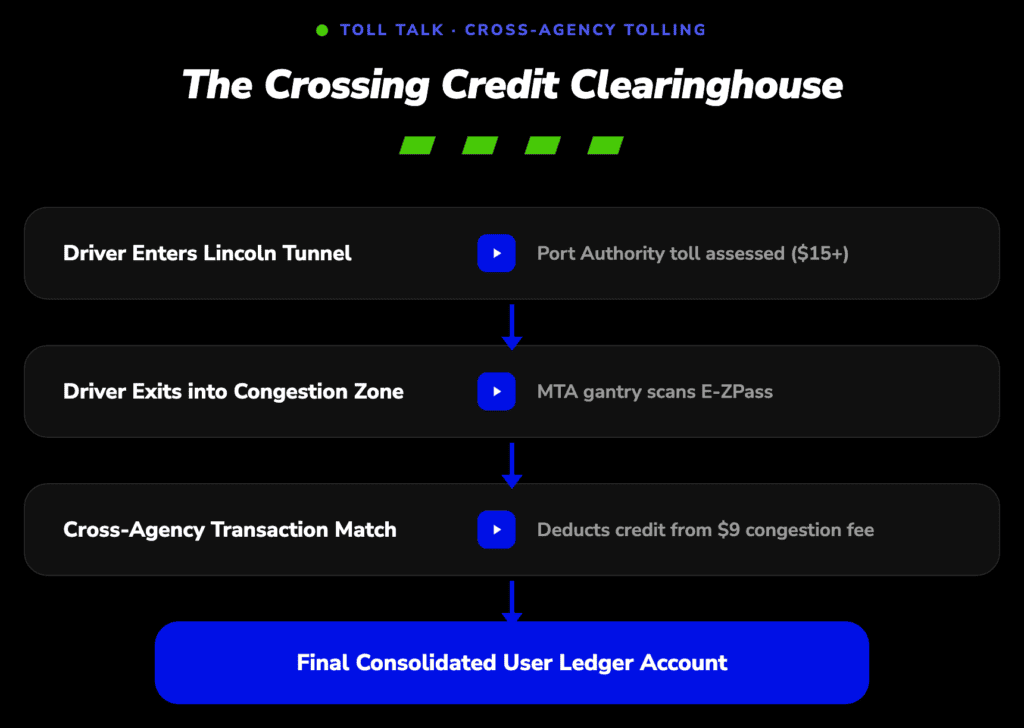
On paper, the math is straightforward. In practice, executing this requires a massive, near-real-time data-sharing dance between two completely separate regional giants: the MTA and the Port Authority of New York and New Jersey (PANYNJ).
The Multi-Agency Ledger Battle
When a commuter passes through the Lincoln Tunnel (managed by the Port Authority) and immediately passes beneath an MTA congestion pricing gantry on 9th Avenue, two distinct back-office systems must reconcile the transactions. The system must verify that the exact same transponder or license plate was read at both locations within a tight, validated time window.
During the initial weeks, system latencies resulted in “phantom charges,” where commuters were billed the full $9 because the Port Authority’s transaction data hadn’t cleared the regional interoperability hub fast enough to offset the MTA’s instant gantry invoice.
Fintech engineers have resolved this by introducing a delayed-settlement logic window. Instead of posting the congestion charge instantly to the user’s ledger, the transaction is held in a “pending reconciliation” state for up to 48 hours, allowing cross-agency data batches to align perfectly. While this fixed the double-billing error rate, it created a floating balance issue that tolling back-offices are still actively optimizing.
The 75% Overnight Discount: Is Freight Traffic Actually Shifting?
To keep Manhattan’s supply chains moving without choking daytime traffic, the program relies heavily on a 75% overnight discount. Between 9:00 PM and 5:00 AM on weekdays, the passenger toll drops to just $2.25, and commercial truck rates drop proportionally.
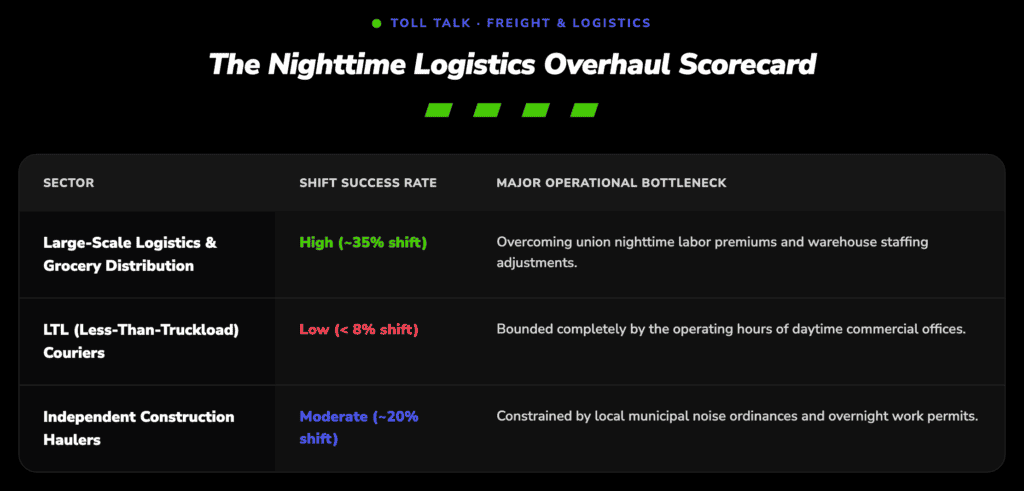
The policy goal was clear: incentivize heavy freight haulers, food distributors, and waste management fleets to abandon daytime deliveries and operate exclusively under the cover of darkness. Mid-2026 data shows that while the incentive is highly effective for certain specific enterprise sectors, it has exposed deep structural realities in others.
The Nighttime Labor Premium Conflict
Major supermarket chains and large-scale distribution hubs have successfully adapted, shifting heavy tractor-trailer arrivals to 2:00 AM. The $20+ savings per truck per day adds up quickly for a fleet running 50 trucks into the city daily.
However, mid-sized and independent logistics firms are finding that the financial savings of the 75% toll discount are frequently wiped out by the increased cost of nighttime labor premiums. Drivers, warehouse workers, and dock managers command significantly higher wages to work the third shift, meaning the toll reduction must be weighed against a rising corporate payroll.
The Receiver Problem
The greatest roadblock to the success of the overnight shift is what transport economists call “The Receiver Problem.” A delivery truck can easily drive through the Lincoln Tunnel at 3:00 AM for a fraction of the cost, but if the retail storefront, corporate office, or apparel boutique in Midtown Manhattan is locked with no staff on site to sign for the inventory, the trip is useless.
Until commercial landlords and retail tenants adopt secure, automated key-drop boxes or unmanned smart-locker delivery systems, the daytime hours will remain stubbornly crowded with delivery vans willing to pay the peak premium as a cost of doing business.
The Roadside Tech Under Fire: Combating Plate Defacement and Fraud
No infrastructure system can survive if its revenue base actively evades enforcement. In New York City, toll evasion has escalated from a minor nuisance into a highly coordinated illicit market, forcing the MTA’s roadside technology to undergo an aggressive, AI-driven upgrade.
When cashless tolling replaced physical token booths, it created an unintended incentive for bad actors to obscure their vehicle identifiers. By mid-2026, tolling operators on Manhattan’s periphery are encountering an unprecedented variety of evasion techniques:
- Mechanical plate flippers that hide the tag at the press of a button.
- Reflective chemical sprays designed to blind infrared camera flashes.
- Fraudulent temporary paper tags printed from out-of-state DMV templates.
- Physical obstruction, ranging from strategically placed dirt to tinted plastic covers.
To defend the system’s financial integrity, the MTA has deployed advanced Edge-Computing Video Analytics across all sixty entry points along the 60th Street perimeter and highway exits.
Digital Vehicle Fingerprinting
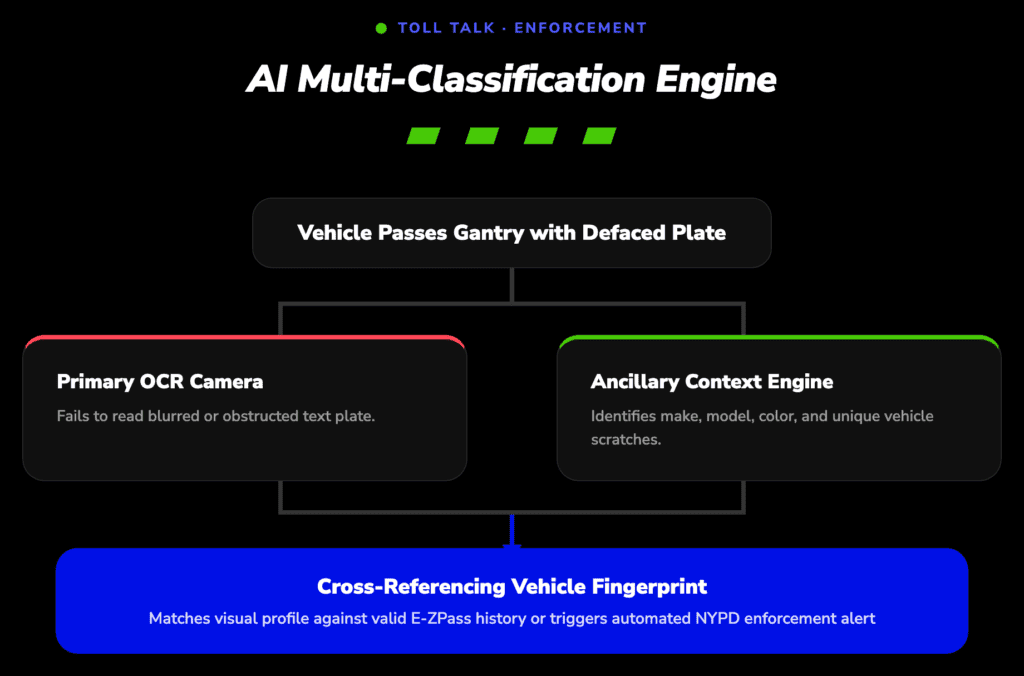
When a vehicle passes under a gantry with a defaced, unreadable license plate, the primary optical character recognition software fails. In a legacy system, that transaction was written off as unbillable leakage.
The 2026 system combats this by instantly passing the image file to an ancillary context engine. This machine learning system evaluates the vehicle’s unique visual profile—extracting its precise color spectrum, roof rack configuration, distinct scratch patterns, and aftermarket wheels.
This creates a digital “vehicle fingerprint.” If this car has a valid E-ZPass associated with it from previous clear reads, the system can retroactively match the transaction to the correct account with a high degree of confidence.
Real-Time Interdiction Links
For completely unidentifiable vehicles operating with illegal or stolen plates, the technology shifts from a billing collection tool to an active law enforcement asset.
The moment a gantry identifies a vehicle with a known fraudulent paper plate or an active “plate flipper” configuration, it drops a high-priority alert into a shared data stream accessible by the New York Police Department (NYPD) and MTA Bridge and Tunnel enforcement units stationed blocks away. By transforming the gantry from a passive camera into an active real-time interdiction sensor, the city has significantly driven down the total percentage of unbillable core crossings.
The Local Micro-Wars: Air Quality, Sixth Avenue, and the Diversion Effect
While the technological and financial systems churn in the background, the physical reality on Manhattan’s pavement has sparked intense localized hyper-local disputes. Congestion pricing does not eliminate traffic; it redistributes it. Managing that redistribution has become a complex civic challenge.
The Sixth Avenue Bottleneck and Bike Infrastructure
With the implementation of the toll, passenger vehicle traffic entering the core dropped by roughly 12% in the opening months. While transit advocates celebrated this as an outright victory, the interior avenues of Manhattan quickly became operational battlegrounds.
The city used the reduced vehicle volume on Sixth Avenue to aggressively expand its protected bike lanes and dedicated pedestrian plazas.
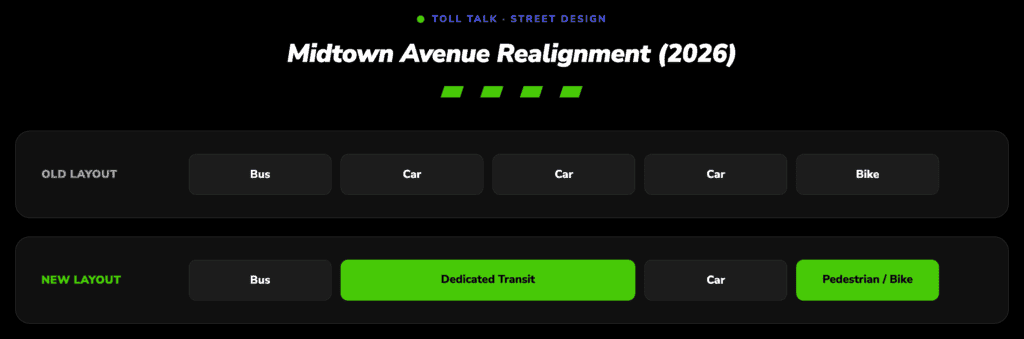
This structural reduction in car lanes meant that the remaining vehicles—predominantly yellow cabs, Ubers, and commercial box trucks—were forced into a narrower corridor. Paradoxically, while there are fewer total cars in Midtown, the localized velocity of those vehicles has occasionally slowed due to the reduced asphalt footprint, highlighting the reality that urban street design must evolve alongside road pricing.
The Outer-Borough Diversion and Air Quality Enforcement
The most intense political friction surrounding the Congestion Relief Zone is happening at its borders. Residents of the Bronx, Staten Island, and the outer edges of Queens have raised alarms regarding the “diversion effect.”
Heavy commercial trucks seeking to completely bypass the Manhattan toll are rerouting around the core, packing onto the Cross Bronx Expressway and the Staten Island Expressway in record numbers.
Community advocates have utilized localized air quality monitors to point out sudden spikes in particulate matter ($PM_{2.5}$) along these peripheral expressways. In response, the MTA has been forced to allocate a significant portion of its early congestion revenue directly to outer-borough environmental mitigation funds. This includes financing the electrification of school buses, installing heavy-duty air filtration systems in public schools adjacent to major highways, and expanding green freight distribution hubs outside the urban center.
The Toll Talk Takeaway: What the Rest of the World Must Learn from NYC
As New York City crosses the mid-2026 mark, the narrative surrounding the Congestion Relief Zone is shifting from political theater to objective operational science. The key takeaway for our industry is that urban congestion pricing is fundamentally a data management and customer trust challenge, not an asphalt challenge.
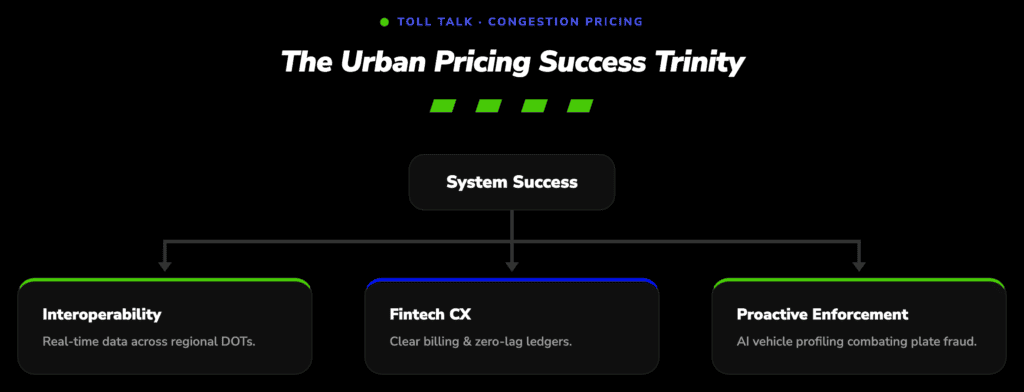
The lessons learned on 60th Street prove that launching a modern tolling system requires focusing intensely on three critical fronts:
- Dynamic Interoperability is Mandatory: You cannot build an urban toll zone in isolation. If your back-office systems cannot process multi-agency data streams with low latency, your customers will suffer from billing chaos.
- Fintech is the Front Line of Public Relations: The fastest way to lose public support is through an ambiguous, hard-to-navigate billing interface. Users demand instant transaction clarity, simple digital wallets, and automated dispute channels.
- Proactive Enforcement Safeguards the Revenue Base: Cashless toll networks must anticipate aggressive evasion. Investing in edge AI video analytics and multi-sensor tracking is an absolute requirement to protect system equity and stop honest commuters from subsidizing bad actors.
Manhattan has proven that congestion pricing is a viable, high-yield tool for financing modern transit and rebuilding urban space. The tech works, the revenue is real, and the gridlock is loosening. The only question left is which global city will have the political will to follow New York’s lead next.