A Completed Project Worth Understanding in Detail
On January 20, 2026, TransCore announced what most press releases would describe as a milestone and most agency executives would recognize as a war story with a good ending. TransCore announced the successful completion of the all-electronic tolling conversion on the 44-mile Atlantic City Expressway for the South Jersey Transportation Authority. As part of the project, TransCore served as the system integrator, designing and installing the new tolling system and delivering a fully electronic, all-overhead open-road tolling environment. Transcore
Eight months of active construction. Ten overhead gantries. A live, high-volume corridor connecting the Philadelphia region to the Jersey Shore — with all the seasonal traffic complexity that implies. And a team that accelerated the final go-live push through the holiday period to hit an early January launch date.
“This achievement is the result of a highly collaborative effort between SJTA and TransCore, with both teams working closely together to meet an ambitious implementation schedule. The strong partnership with TransCore throughout the project was exemplified as our teams worked hand-in-hand to accelerate the go-live effort over the holidays, ensuring a smooth transition to a modern, cashless tolling environment for motorists as 2026 began,” Transcore said SJTA Executive Director Stephen F. Dougherty.
This post uses the ACE conversion as a frame to explain what an AET conversion actually involves — and what every agency evaluating its own conversion timeline should be asking before signing a long-term operations and maintenance contract.
Why the ACE Conversion Matters Beyond New Jersey
The Atlantic City Expressway is not a landmark project because of its size. At 44 miles and 10 gantries, it sits well within the normal range of corridor conversion complexity. It matters because of what it represents: a concrete, recently completed, publicly documented example of how a mid-sized highway authority in 2025-2026 executed a full transition from traditional tolling to all-overhead open-road tolling — from procurement through phased installation through live operations.
This project also sets a benchmark for digital tolling upgrades, establishing a replicable model that can be applied to other major corridors across New Jersey. Transcore That framing — replicable model — is the most important phrase in the press release for anyone in the industry. Because the pattern the ACE represents is happening at highway authorities across the country right now.
Open road tolling is an increasingly popular alternative which eliminates toll booths altogether; electronic license plate readers mounted beside or over the road read transponders as vehicles pass at highway speeds, eliminating traffic bottlenecks created by vehicles slowing down to go through. Wikipedia The list of recent conversions is long and growing: the Kansas Turnpike went fully cashless in July 2024, the Oklahoma turnpikes converted in November 2024, and the Delaware River Joint Toll Bridge Commission is currently mid-conversion on seven legacy cash-collection bridges with an open-road AET target of summer 2026. Every one of these projects involves the same core decisions, the same procurement process, and the same operational handoff challenges — just at different scales and on different timelines.
Understanding what happened on the Atlantic City Expressway is understanding what is happening everywhere.
What “All-Electronic” Actually Means in Practice
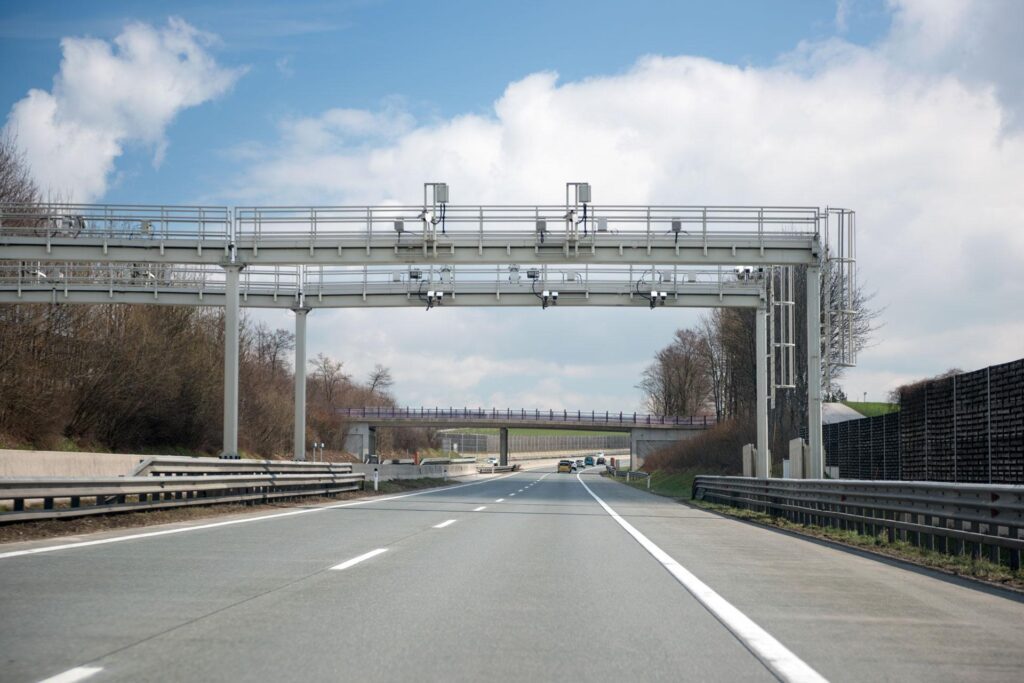
Before getting to the technology decisions, it’s worth grounding the terminology. All-electronic tolling (AET) — also called open-road tolling (ORT) or cashless tolling — means no toll booths, no cash, no stopping. Vehicles pass under overhead gantries at highway speed. Transponder-equipped vehicles are charged automatically. Non-transponder vehicles are identified by license plate camera and billed by mail.
That sounds simple. The operational reality is more layered.
While the cost to collect each toll using AET is less than half of the cost to collect using manual tolling, processing violations — customers who use an AET lane without the appropriate transponder — are 72 percent more costly than a transponder-based AET toll. A-to-be This is the central tension of every AET conversion: the efficiency gains from eliminating booth labor and accelerating traffic flow are real and significant, but they create a downstream collection problem that requires its own infrastructure — back-office systems, payment portals, violation processing, customer service operations, and enforcement programs — to manage.
To fully realize AET’s benefits of greater safety, congestion relief, a cleaner environment, long-term cost reductions, and customer convenience, toll agencies sacrifice a certain percentage of revenue, which the industry commonly refers to as “leakage.” Leakage is primarily attributed to the use of license plate-based tolling, particularly the invoicing approach that requires agencies to identify customers after travel, invoice them by mail, and then wait for payment. HNTB
A new AET system is not just a gantry installation project. It is also a payment operations modernization project. Agencies that treat it only as the former end up managing the consequences of the latter for years afterward.
The Technology Decision: What “Next-Generation” Actually Means
The ACE conversion deployed TransCore’s Infinity VCATS — the vehicle capture system at the heart of the new infrastructure. Understanding what that means technically is useful for any agency evaluating vendors.
The Atlantic City Expressway deployment utilizes TransCore’s next-generation Infinity VCATS (Vehicle Capture and Tracking System), an all-overhead, AI-powered tolling solution designed to deliver industry-leading accuracy without the need for in-road sensors. Using advanced machine vision and vehicle tracking technology, the system enables precise vehicle detection, axle-based vehicle classification at highway speeds, supporting reliable all-electronic tolling across complex, high-volume corridors. GlobeNewswire
The “without the need for in-road sensors” phrase is significant. Traditional tolling systems relied heavily on in-pavement loop detectors and other embedded sensors for vehicle detection and classification. Those sensors are expensive to install, expensive to maintain, and vulnerable to wear from weather and heavy traffic. An all-overhead system that achieves equivalent accuracy through machine vision and neural network processing eliminates a major ongoing maintenance cost and a common failure point.
TransCore deployed the same Infinity VCATS platform on the Tacoma Narrows Bridge upgrade in October 2025. That project also features TransCore’s latest AI-based overhead Vehicle Classification and Tracking System (VCATS), Vehicle Capture and Recognition System (VCARS), and state-of-the-art automatic license plate recognition (ALPR) solution to operate at the highest possible level of automation and reduce operational overhead. These modular subsystems work together to deliver flexible, future-ready, and highly accurate vehicle classification without the need for in-pavement sensors. GlobeNewswire
The modular architecture matters too. TransCore’s scalable technologies, including VCATS and SmartPass, provide a seamless upgrade path for legacy Infinity Digital Lane Systems, allowing agencies to adopt next-generation tolling innovations over time without disruptive infrastructure changes. ST Engineering For agencies with existing TransCore infrastructure, this means a conversion doesn’t require a full rip-and-replace — components can be upgraded incrementally as technology evolves and budgets allow.
The Systems Integrator Role: More Than Hardware Installation
One aspect of the ACE project that deserves attention is the scope of TransCore’s role. The announcement describes TransCore not as an equipment vendor but as the systems integrator — responsible for designing and installing the system, and for operating and maintaining it going forward.
That distinction matters. A systems integrator takes ownership of the outcome, not just the components. They are accountable for how the camera interacts with the license plate recognition software, how the LPR feeds into the back-office transaction processor, how the back-office feeds into the violation management system, and how the violation management system communicates with the customer-facing payment portal. When those handoffs break down — and they do break down — the agency has one number to call.
The alternative, which many agencies have lived through, is a fragmented vendor landscape: one contractor for gantries, another for transponder readers, a third for LPR, a fourth for back-office, a fifth for violation processing. In one notable example, the New Jersey E-ZPass regional consortium’s Violation Enforcement contractor did not have access to the Transaction Processing contractor’s database of customers. This, together with installation problems in the automated vehicle identification system, led to many customers receiving erroneous violation notices, and a violation system whose net income, after expenses, was negative, as well as customer dissatisfaction. Wikipedia
That happened on a New Jersey toll system. The lessons have not been universally absorbed.
The Trade-Off Built Into Every AET Conversion
Here is the honest operational picture that agency directors need to hold in their heads simultaneously when evaluating an AET conversion:
The gains are real. ETC systems provide cost savings of over $40,000 per lane in equipment costs and $135,000 per lane in annual operating and maintenance costs compared to manual tollbooths. Tamu Traffic flow improves dramatically. Congestion at toll points is eliminated. Safety for both motorists and workers improves — no booth attendants exposed to exhaust and vehicle proximity risk. And for a corridor like the Atlantic City Expressway, which handles large seasonal peak volumes, the capacity gains during summer shore traffic are operationally significant.
The leakage problem is real too. Non-collection of toll revenue is a managed and stable situation, in line with agencies’ projected financial performance prior to cashless AET conversions. It is important to distinguish between revenue “leakage” and “loss.” Leakage is a cost of doing business rather than a loss. IBTTA That framing from IBTTA is the mature industry view: leakage is anticipated, modeled in financial projections, and offset in toll rate structures. It is not a surprise. But it is a cost, and it is a cost that grows if the payment experience for non-transponder drivers is poor.
The ACE has already addressed one dimension of this: commissioners approved a plan that will require drivers who do not use E-ZPass to pay double the standard toll. The surcharge is intended to offset the added cost of processing non-E-ZPass transactions. 42 Freeway The double-toll structure for plate-based billing is an increasingly common approach — it creates a financial incentive for transponder adoption while funding the back-office cost of processing paper invoices. But it works only if the payment experience for those receiving invoices is frictionless enough to convert them rather than driving them to avoidance.
What Agencies on the Procurement Side Should Be Asking
The ACE conversion provides a useful checklist template for any agency currently evaluating an AET conversion or re-procurement. Here are the questions that matter most — and that don’t always get asked in RFPs.
On the technology: What is the system’s documented accuracy rate under real-world conditions — not controlled testing? What happens when a plate is damaged, obscured, or from a single-plate state? Does the vehicle classification system depend on in-pavement sensors that require road disruption to install and maintain, or is it fully overhead? What is the upgrade path as AI and machine vision continue to improve — can components be updated without full system replacement?
On the integration: Who owns the connection between lane hardware and back-office? Between back-office and violation processing? Between violation processing and customer-facing payment? What is the contractual accountability if a handoff between subsystems breaks down and generates erroneous violation notices at scale?
On operations and maintenance: Is the integrator taking on long-term O&M as TransCore did with SJTA, or handing off to the agency at go-live? If the latter, what internal capacity does the agency need to build, and on what timeline? What are the SLAs for system uptime, and what are the contractual remedies for underperformance? Toll agencies are identifying and quantifying their sources of lost revenue through a process called revenue assurance data mapping — a complete accounting of the disposition of all agency transactions under current toll collection methods. The results form a “you are here” map of where the organization stands in terms of revenue collection efficiency. HNTB Has the agency done this mapping before the procurement, so they know what baseline they’re converting from?
On scalability: With the system now fully deployed, it supports uninterrupted travel across the entire expressway while providing scalability for future enhancements. Transcore What does “scalability for future enhancements” mean specifically in the contract? If the agency wants to add managed lanes, dynamic pricing, or connected vehicle credential-based tolling in five years, is the installed infrastructure actually capable of supporting those changes — or does “scalability” mean a new procurement?
On the payment experience: This is the question most AET RFPs still don’t ask loudly enough. Despite the promise of all-electronic tolling to improve efficiency and reduce traffic congestion, agencies are losing an estimated $2.24 billion annually in uncollected toll revenue. PayNearMe The gantry system captures the transaction. The payment system collects the money. They are not the same problem, and they require different vendor conversations. A world-class vehicle capture system producing invoices that go to a broken payment portal is a partial solution.
The Pattern Repeating Across the Country
The Atlantic City Expressway is one data point in a national pattern of corridor conversions that has been accelerating for years and will continue accelerating as remaining holdout agencies face the combination of aging booth infrastructure, labor cost pressures, and increasingly cheap all-overhead technology.
Today, all-electronic tolling is the standard toll collection method in the US. The toll industry’s path to AET 3.0 could mirror transponder adoption in the 1990s when cash-only toll agencies added equipment to their toll plazas and accepted transponders. As saturation of transponders increased and became the primary payment source, agencies reduced or eliminated cash collections to realize AET’s benefits. HNTB
The next generation — AET 3.0 in HNTB’s framing — involves fixed in-vehicle payments through connected vehicle technology that eliminates even the license plate lookup step. Fixed in-vehicle toll collection is coming, but it will be another generation or two of toll systems and operations before the technology reaches full market penetration. Toll agencies hungry to stem leakage and optimize their AET operations in the meantime don’t have to wait. HNTB
That’s the practical message for agencies currently evaluating conversions: don’t wait for AET 3.0 before building AET 2.0. The corridors converting now — the Atlantic City Expressway, the Delaware River bridges, the Kansas Turnpike — are not making a bet on current technology being the final word. They’re building infrastructure that is scalable forward, while capturing the operational and safety benefits of going cashless now.
The agencies that haven’t converted yet are not facing a technology question. They’re facing a project management and procurement question — and the ACE conversion gives them a concrete, recently completed, publicly documented answer to what that looks like when it goes right.
Sources
- TransCore / GlobeNewswire — TransCore and SJTA Complete All-Electronic Tolling Conversion on the Atlantic City Expressway (January 20, 2026) — globenewswire.com
- 42Freeway — Atlantic City Expressway Toll Increase; Cashless Gantry System Explained (December 2025) — 42freeway.com
- TransCore / GlobeNewswire — Tacoma Narrows Bridge Tolling System Upgraded with TransCore’s Next-Generation Technology (October 2025) — globenewswire.com
- TransCore / ST Engineering — TransCore to Support Delaware River Joint Toll Bridge Commission’s Transition to All-Electronic Tolling (June 2025) — stengg.com
- HNTB — Envisioning the Future of Tolling — hntb.com
- A-to-Be White Paper — All-Electronic Tolling: Saving the Environment, Your Wallet — a-to-be.com
- IBTTA — Electronic Tolling Interoperability: Setting the Record Straight — ibtta.org
- Texas A&M TTI — Electronic Toll Collection Systems, Transportation Policy Research — policy.tti.tamu.edu
- Arcadis — All Electronic Tolling: Should Agencies Make the Switch? — arcadis.com
- PayNearMe — The Impact of Payment Experience on Toll Revenue Leakage — home.paynearme.com